

When Is a Private Mold Worth It for a Glass Bottle Project?
Decide if a private mold is worth it by comparing volume, differentiation, tooling risk, sample rounds, cost recovery, IP needs and reorder plans.

For buyers assessing When Is a Private Mold Worth It for a Glass Bottle Project, the practical choice depends on the product, components, finish, order route, and packing conditions rather than appearance or unit price alone. Use custom perfume bottles as the starting requirement, then ask the supplier to connect each proposed option to a drawing, a representative sample, compatible parts, and the final export pack. Compare what each quotation includes, identify which sample proves each decision, and agree on the checks that will be repeated before shipment. This approach keeps the discussion focused on sourcing risk and creates a clear record for production and future reorders.
A private mold is worth it when the new shape solves a brand, fit or exclusivity problem that stock bottles cannot solve and the reorder plan can absorb tooling risk.
Buyers often compare only the first visual sample. A better decision starts with the full sourcing file: product use, target capacity, neck finish, decoration area, closure, carton route, sample stage and reorder plan. The primary keyword custom perfume bottles belongs in that file only when it describes the actual project, while related terms such as custom fragrance bottles, glass perfume bottle, liquor bottle, cosmetic bottle should support the decision rather than replace it.
Buying Decision Matrix
| Decision area | What to confirm | Risk if ignored |
|---|---|---|
| Brand differentiation | Unique silhouette, base, shoulder, texture or embossing | If a stock bottle can carry the brand, private tooling may not pay back |
| Functional need | Special closure fit, dosing, grip, fill line or carton footprint | Private mold is stronger when shape improves use or packing |
| Volume plan | Repeat orders that can spread tooling and sample cost | Small one-time runs usually struggle to justify mold work |
| Approval risk | 3D drawings, prototype, sample mold and production mold stages | Each late design change can reopen timing and cost |
| Decision rule | Use private mold for owned shape or fit advantage | Use public mold when speed, budget and proven dimensions matter more |
What to Confirm Before Sampling
Private mold discussions should start with target capacity, overflow capacity, weight, neck finish, closure model, decoration zones, carton size and expected annual volume. Without those inputs, tooling quotes are not comparable.
The first sample should prove the detail that makes this topic important. For decoration projects, that means the actual glass color or coating, the real printable area, the intended foil or ink system and the contact points created by packing. For mold projects, it means the actual neck finish, base weight, shoulder radius, embossing area and sample stage. A quotation is only comparable when both suppliers are quoting the same technical boundary.
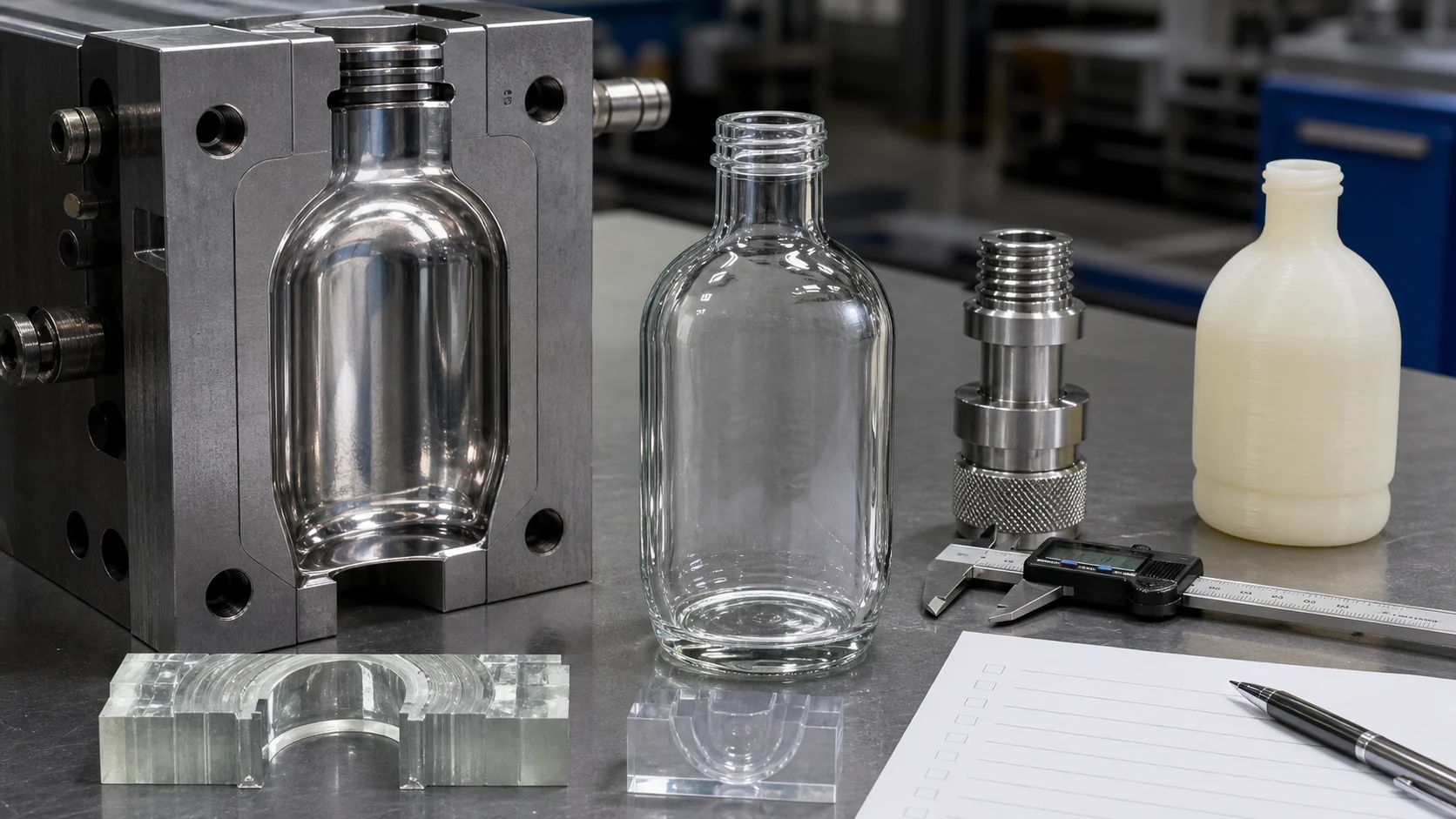
Technical Checks That Change the Answer
Use published standards and equipment references as vocabulary, not as invented pass/fail limits. ASTM D3359 is useful language for tape adhesion discussions. ASTM D5264 is useful language for abrasion and scuff discussions. Glass forming references from GPI, Bucher Emhart Glass, Heye International and mold suppliers explain why a bottle is not just a drawing: the blank mold, blow mold, neck ring, cooling route and sample revisions all affect what can be repeated in production.
Ask for evidence in a form that the factory and your receiving team can both use: dated photos, sample labels, component model numbers, final artwork files, measured neck finish, carton construction, and a short note stating which variables are locked. If a supplier changes a foil, ink, coating, label stock, mold insert, cap, pump, stopper, carton divider or packing sleeve, the change should be reviewed before mass production.
Common Failure Modes
- A premium detail looks correct on a loose sample but rubs or scuffs after carton contact.
- A flat artwork proof hides distortion that appears on the bottle shoulder, heel or label panel.
- A private mold shape looks distinctive but creates closure-fit, filling or packing questions that were not priced.
- A design change after the sample mold forces another revision round and resets approval timing.
- A public mold quote and a private mold quote are compared even though one includes decoration, closure and carton and the other does not.
Sample Approval Record
Keep one control sample and a photo record for every major stage. Decoration records should include color references, viewing light, foil or ink area, label edge, adhesion language, rub-contact notes and packed-sample observations. Mold records should include drawings, capacity target, overflow capacity, glass weight target, neck finish, closure model, base detail, embossing depth, carton fit and any accepted dimensional notes from the supplier.
Do not approve a sample only from a beauty photo. Pull the part into its real use case: fill it, close it, pack it, handle it and compare it with the next sample. If the project is for fragrance, cosmetic, liquor, food or diffuser use, ask whether the test liquid, fill level and contact time are representative. If the project is for an owned shape, ask whether the quoted mold stage is a sample mold, production mold or revision after first trial.
Commercial Trade-Off
The lowest quote is not automatically the best quote. Hot stamping may cost more than a simple label but can remove label edges and make a small metallic accent feel integrated. Detailed artwork may require simplification before screen printing but may work as a label. A private mold can create real brand ownership but only makes sense when repeat volume, margin or functional advantage justifies tooling. A public mold can be the smarter route when speed, known fit and lower launch risk matter more.
Write the trade-off in the RFQ. Tell suppliers whether the priority is speed, exclusivity, lowest development cost, decoration durability, premium shelf impact, closure fit, packing efficiency or reorder consistency. That lets them recommend a route instead of quoting a vague concept.
Buyer Checklist
- Define the complete assembly before comparing prices.
- Approve the detail on the real bottle shape, not only on a flat proof or rendering.
- Use packed samples when rubbing, scuffing, label lift, leakage or carton fit could change the result.
- Record which design, decoration, closure or packing changes require buyer reapproval.
- Keep the final decision tied to the business reason: premium effect, technical fit, brand ownership, speed or cost control.
RFQ Wording Buyers Can Reuse
In the RFQ, describe the decision in operational language. State the bottle type, target capacity, expected decoration or mold feature, closure model, filling method, order quantity, destination market and sample deadline. Then ask the supplier to separate standard items from project-specific items. Standard items may include an existing public mold, existing cap model, ordinary carton or known decoration process. Project-specific items may include private tooling, a new foil zone, a revised screen, a special label stock, custom neck-ring work, embossing, a heavier base or a packing insert that touches the decorated face.
This wording helps the supplier return a quotation that can be audited. It also prevents a common problem in glass sourcing: one quote includes only the bare container while another includes closure, decoration, carton, sampling and testing. Ask each supplier to list exclusions. If a cost is not included, it should be visible before the buyer compares unit prices. That habit is especially useful when the same sourcing team compares custom perfume bottles with adjacent projects such as custom fragrance bottles, glass perfume bottle.
Receiving Inspection Notes
After mass production, receiving inspection should mirror the sample approval record. Pull bottles from different cartons and pallet positions, compare them with the approved control sample, and photograph both acceptable and questionable examples. For decoration articles, inspect the display face, the side curves, the base edge and any surface that touched dividers or sleeves. For mold articles, check the details that made the mold decision expensive: neck finish, shoulder shape, base detail, embossing, wall impression, carton fit and closure compatibility. If the incoming lot fails, the report should identify whether the issue is cosmetic, functional, packing-related or caused by a changed component.
Decision Rule
Choose the route that can be repeated with the least hidden risk. If the visual effect, mold detail or artwork requirement cannot be defined, sampled, packed and reordered clearly, simplify the design before moving to mass production.
 Scan WhatsApp
+86 173 6846 7899
Scan WhatsApp
+86 173 6846 7899